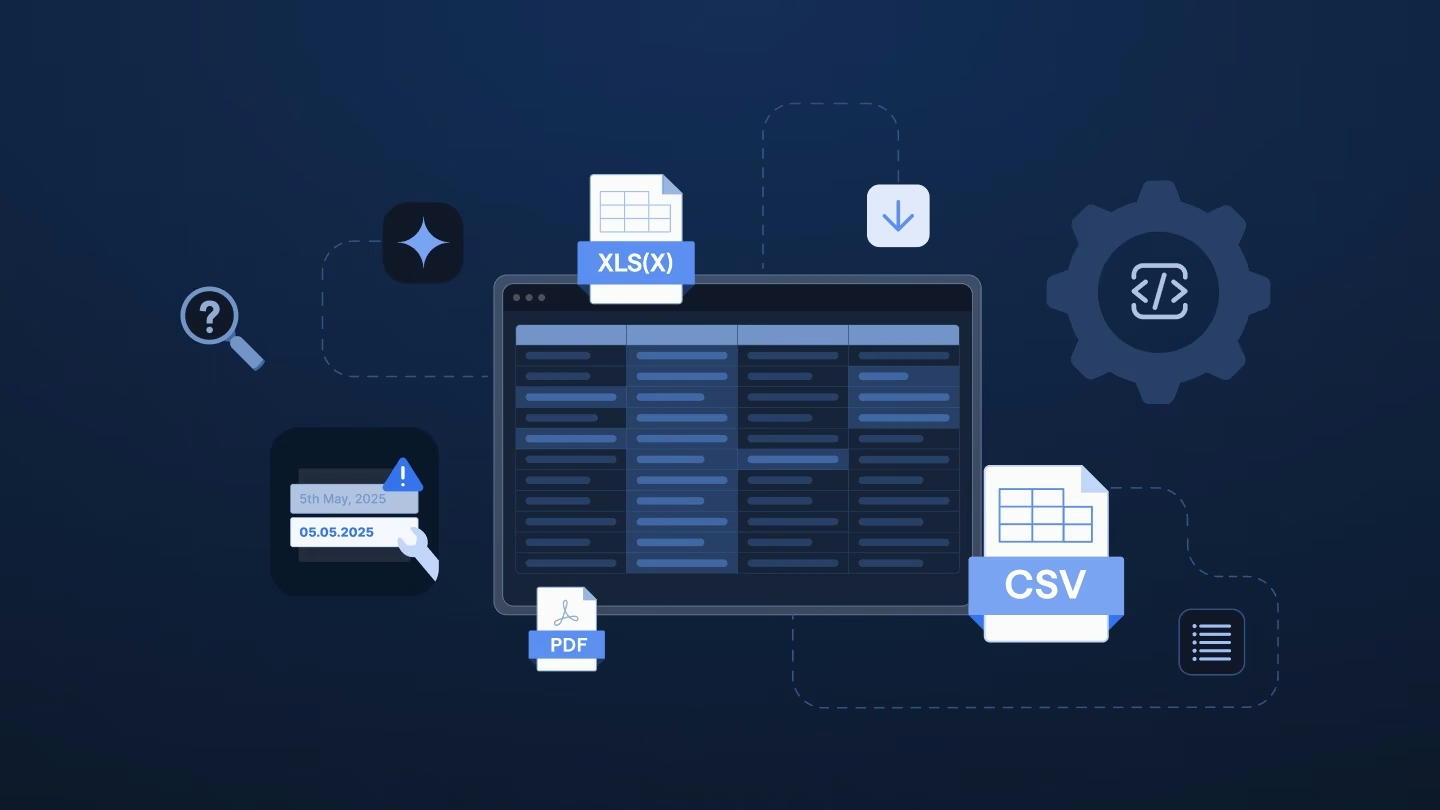
Custom import scripts often start as a quick fix for one customer. However, as you onboard more customers with different data formats, the scripts need regular updates. Even small file changes can require new code, turning a simple solution into a full-time maintenance job.
Many implementation, onboarding, and professional services teams now rebuild a lighter version in-house with AI coding tools. That works for simple files but gets challenging when hundreds of files arrive from different sources – and several teams need to handle them.
This guide compares five alternatives, from SDKs to complete platforms, and shows which problem each one fits. It also gives you a checklist for evaluating any option not covered here, so that you can judge it against your own file volume and team setup.
Here’s a direct comparison: CSVBox and Dromo are embeddable importers (SDKs), Flatfile is a migration workspace, and OneSchema and Ingestro are purpose-built platforms for automating data operations using AI agents.
“Custom import script” is a broad label for a lot of “hidden” work. Teams we’ve talked with describe their current process bluntly: a copy-paste exercise, or a spreadsheet full of VLOOKUPs, depending on what the customer sent that week. Underneath sits a fairly consistent list of responsibilities:
That last item is the one teams underestimate.
A script built for one customer’s export format works fine until the next customer sends the same data with different headers, a different date format, or an extra worksheet. Then someone – typically whoever wrote the original script – has to go back in and adjust it.
Multiply that by dozens or hundreds of customers. “Data import” stops being a one-time build and becomes an open-ended maintenance line.
AI tools have made it much easier to write a script for a task like this, so many teams now handle simple CSV cleanups in-house. That works when the file is simple, the format is stable, and one team owns the result.
The balance shifts when you need to repeat, share, and supervise the same work across teams. A script typically doesn’t come with user management, retention rules, or a way for a non-developer to change the logic.
Ask various organizations what “high volume” means, and you rarely hear row counts. They talk about file sizes and want a high-performing setup that doesn’t break under load.
What they typically mean is scale: hundreds or thousands of files, from many customers and sources, handled by several teams, often at the same time.
Volume also isn’t steady. One team we spoke with said their file volume wasn’t linear across the year: it spiked hard around certain reporting periods, then dropped back down. A solution sized for an average month can struggle in the weeks that matter most.
That makes a handful of practical questions more useful than any limit on a spec sheet:
Schema variability matters here too. A single 500K-row standardized file can be easier to process than 50 smaller files from 50 different customers.
Those 50 files might carry inconsistent headers, date formats, identifiers, and validation rules. Row count measures one axis of difficulty. The number of formats is another, and it’s often the one that breaks custom scripts first.
This is a category decision before it’s a vendor decision. Custom scripts can hold up in narrower circumstances. A dedicated solution makes more sense in the opposite ones.
Who maintains the import logic often matters more than any single feature, and the last row shows why. In more than one conversation we’ve had with implementation and operations leaders, the reaction to “this will need some engineering time” was immediate: a flat no.
That’s not because engineering couldn’t do the work. Routing customer data prep through an engineering queue can turn a same-day fix into a multi-week wait. And that wait falls on the implementation or operations team’s timeline, not engineering’s.
There’s a caveat worth naming, too: “no-code” doesn’t mean zero engineering. Every embedded or self-hosted solution needs engineering involvement during initial setup and again when the hosting environment needs troubleshooting.
What a platform changes is who does the day-to-day work. Mapping, validation, and cleaning move to implementation and onboarding teams. A specialized BI, operations, or automation team typically supports them instead of engineering.
Each solution below gets the same four questions: what it is, what type of import problem it solves, where it fits, and what to weigh. Descriptions come from each vendor’s own product pages and documentation, accessed in September 2026. Confirm current details before you commit, since they can change.
What it is: An embeddable CSV and Excel import widget you add to a SaaS product with a single script snippet. It’s an SDK, not a platform.
What type of import problem it solves: The lightweight, developer-first end of the category. It puts a white-labeled upload, mapping, and validation flow inside a product without anyone building parsing and mapping logic from scratch.
Where it fits: SaaS products that need a user-friendly, embedded upload, with engineering owning the integration. It mainly competes with in-house builds for simple tasks, where no repeatable, infrastructure-relevant workflow has to be shared across teams.
What to weigh: CSVBox includes AI-powered column mapping and SOC 2 plus GDPR coverage on its plans. Recurring, scheduled ingestion outside a user-initiated upload isn’t part of the core product.
It’s aimed at the single-upload case rather than at several teams working through many files. If the task is a basic import for one stable format, consider building it in-house.
What it is: A data operations platform combining AI-assisted data processing, a shared spreadsheet workspace (Studio), and automated file integrations (Filefeeds).
What type of import problem it solves: Helps operations and product teams import, clean, map, and validate large datasets, with options for automated processing and manual review.
Where it fits: Data operations and product teams managing complex data imports that require collaboration, custom validation, and ongoing oversight. Its broader platform approach may require more setup than a straightforward import solution.
What to weigh: OneSchema and Ingestro are the two platforms in this comparison. Evaluate OneSchema against the questions in the high-volume section below: how it handles many files at once, parallel imports, and work shared across teams.
It also offers regional hosting options and automatic malware scanning on uploaded files. Both are worth a look if data residency or file-borne security risk is part of your evaluation.
What it is: A collaborative data-migration workspace. Flatfile is now the name of the migration product under its parent company, Obvious. Obvious rebranded in 2025 as a general work platform that covers project management and other work well beyond data migration.
What type of import problem it solves: Complex, project-based data migrations, where an internal team and the customer’s team prepare, review, and approve data in the same environment instead of exchanging files by email.
Where it fits: Enterprise implementations and system migrations, where preparation is a multi-stakeholder project rather than a single self-service upload. Professional services and systems-integrator use cases fit especially well.
What to weigh: Flatfile positions itself around reducing manual data-preparation effort in migration projects, and the company states this can cut project time substantially. That figure comes from Flatfile’s own materials rather than independent measurement, so treat it as a starting point for your own evaluation.
The bigger question is direction. Obvious no longer focuses only on data migration, and it’s uncertain whether the migration product will remain the same after the rebrand. Ask how it fits into the company’s roadmap today.
What it is: An AI platform that orchestrates data operations for global software and service providers, turning inconsistent customer files into clean, system-ready data.
What type of import problem it solves: Custom scripts rarely sustain both halves of customer data onboarding: the imports that launch each new implementation, and the recurring files that arrive in inconsistent formats every cycle after go-live. Ingestro covers both in a single platform so that data onboarding can keep pace with a growing customer base.
Where it fits: Implementation, onboarding, operations, and professional services teams managing high-volume, multi-source customer data workflows. The users doing the daily work own data preparation instead of routing every change through engineering, typically with support from a BI, operations, or automation team.
What to weigh: Ingestro can pick up files from the places customers already send them. SFTP drops, email attachments, and manual imports from a services team can all feed the same workflow, which is harder to do with a custom script. It’s built for many files across multiple teams, with user management, retention policies and data compliance controls to support how those teams work. Teams with stricter data-residency requirements can also self-host.
Use this checklist whether you’re evaluating one of the five solutions above or something else entirely. Start with scale and performance:
Then check how files come in and how they’re transformed:
Finally, look at how your team will run it day to day:

Learn how the leading payroll and compliance platform moves customer data globally without manual reformatting.
Read customer storyNone of the five solutions above is the right answer for every team, and a fair comparison shouldn’t pretend otherwise. Which one fits depends on your situation:
Whichever option fits best, the checklist above still applies. Test how the solution handles several files at once, decide who owns maintenance once it’s live, and weigh the variety of file structures and recurring volume as heavily as file size.
See how easily you can turn your customer files into ready-to-use data with Ingestro’s AI agents.




.png)
.png)